1:50, 1:64 or 1:87? Choosing the Right Scale for Your Model Lorry Display
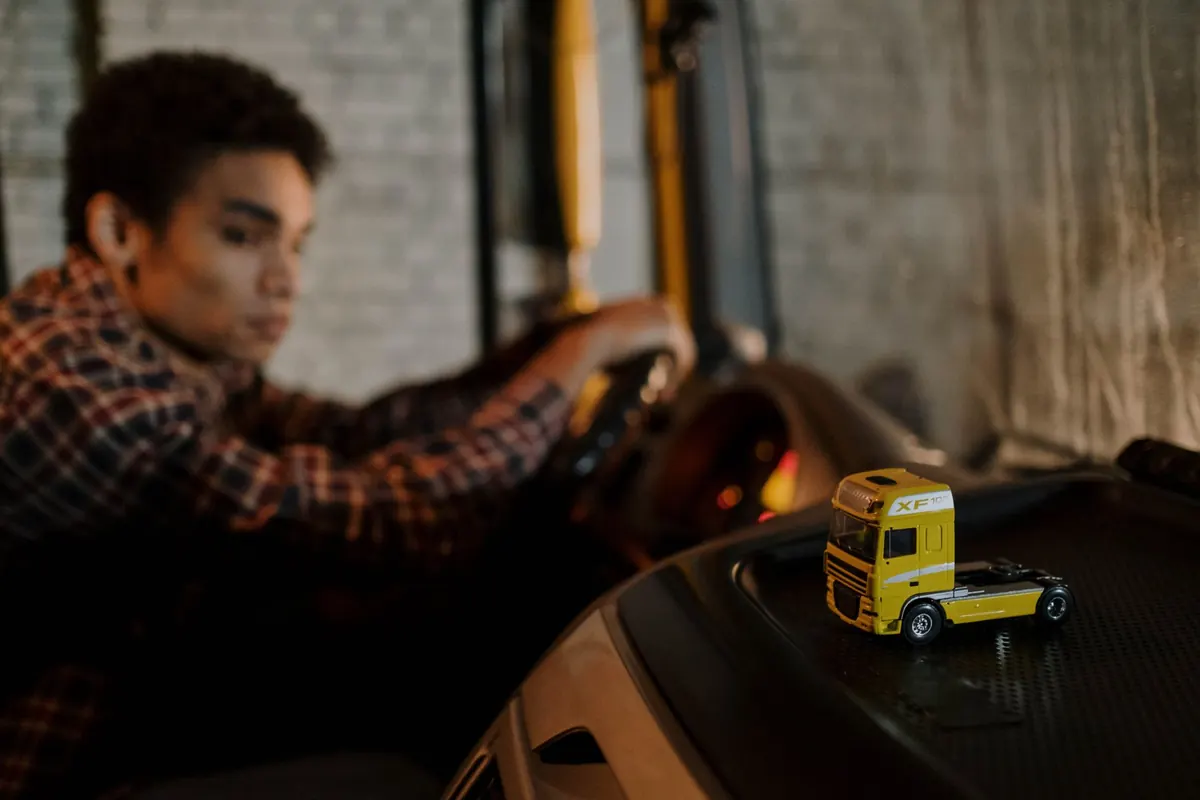
Most collections don't begin with a decision. They begin with a birthday present, a swap-meet find, or a model of the lorry your father drove for twenty years. Then a fourth lorry arrives, you line all four up, and something looks wrong. The Volvo dwarfs the Scania. The little box van looks like it wandered in from a different hobby. That's scale, and it's the choice that quietly shapes everything afterwards: what fits on a shelf, what your budget stretches to, and whether the finished display reads as a collection or a jumble.
Scale is also the decision that's hardest to undo. Moving from 1:87 to 1:50 doesn't mean adding to a collection, it means starting a second one — and a shelf of mismatched sizes looks worse than either scale would on its own. So it's worth half an hour of thinking before the fifth lorry arrives.
What each scale actually looks like
Numbers on a box mean little until you picture the model in your hand. Here is the honest version.
1:87 — the fleet builder
This is model railway territory (HO), which is why the range is so deep. A 16-metre artic works out at around 18 cm, about the length of a television remote; a rigid six-wheeler is roughly 9 cm, about the length of a pen. On a shelf you don't see one lorry, you see a fleet — a dozen artics lined nose to tail, liveries from a dozen operators, angled slightly as if parked in a yard. Herpa, Wiking, Brekina and Rietze all work this scale, and the printed detail on a modern cab is genuinely impressive: grille slats, fleet numbers, the tiny hazard flashes on the rear doors. Just accept that you'll view it from close up. From a few metres away, a 1:87 lorry reads as a shape and a colour, not as a machine.
1:64 — the middle ground
Roughly 25 cm for an articulated lorry, about 10 cm for a rigid. That's the sweet spot for many collectors: big enough for mirror arms, a painted grille and a cab interior you can actually see into, small enough that six or seven models share a shelf. The range leans heavily American — bonneted conventionals, pickups, film vehicles — and 1:64 is often a loose label rather than an exact figure, so treat two models from different brands as roughly comparable, not identical. Buy a Greenlight lorry and a DCP lorry for the same shelf and expect them to look like cousins rather than twins.
1:50 — the display centrepiece
A 1:50 artic stretches about 33 cm, a ruler and a half; a rigid eight-wheeler is around 20 cm. This is the scale of heavy haulage, plant and limited-run collector pieces, and it shows: opening doors, steerable wheels, tilting cabs, working hydraulics on cranes and low loaders, air lines you can hook up. NZG, WSI, Conrad and Tekno live here. It's also where the most interesting subjects exist. If you want a ballast tractor and a girder trailer, or a specific operator's livery from a rally you actually attended, this is where you'll find one — often in a numbered run of a few hundred.
One aside: British collectors will also meet 1:76 (OO gauge), used by Oxford Diecast and others. It's close enough to 1:87 to look wrong beside it, and different enough to notice — a 1:76 lorry on a 1:87 shelf looks like it's had a growth spurt. Keep the two apart.
Space: measure depth before you measure length
Length is the obvious number and the least useful one. Depth catches people out. A cabinet 30 cm deep will take a 1:87 artic with room to angle it slightly; a 1:50 low loader will overhang the front edge and stay there, looking like it's about to fall.
- 1:87: about 25 cm of shelf depth. A metre of shelf holds four artics with breathing room, or eight rigids.
- 1:64: about 35 cm of depth. A metre holds three artics comfortably, or five smaller trucks.
- 1:50: 45 cm of depth if you want to display at an angle. A metre holds two long combinations, three if you stagger them.
Height matters too. A crane with the boom raised, or a lorry with mirrors and an exhaust stack, can add 15–20 cm over the cab roof. Leave a shelf gap of at least 25 cm for 1:50 and you won't be rearranging furniture later. And remember that a shelf is only half the equation: whatever you display will also gather dust, so plan the case or glass door at the same time as the shelving, not after.
If six models of a given scale won't fit in the space you have, you've chosen a scale that's too big for the room — not a shelf that's too small for the hobby.
Budget: fewer models, or more of them
1:87 gives you the most lorries for your money, full stop. That's the scale to choose if your pleasure comes from building a fleet — twenty, thirty, fifty vehicles representing an operator, a decade, a region. A single 1:87 model can cost less than a takeaway, which means you can buy the one you're unsure about without agonising over it.
1:50 is the opposite trade: each model costs more, and limited runs mean the one you want may not be available at any price next year. Buying in 1:50 rewards patience and a list — decide what you're collecting, then wait for it. 1:64 sits between the two, and its range swings from toy-grade castings sold in supermarkets to carefully finished collector pieces, so price alone won't tell you what you're getting. Look at the model, not the number on the shelf edge.
Two costs get forgotten. Shelving and cases, for one: a glass case sized for a 1:50 low loader can cost as much as the low loader itself, and if you skip the case you've committed to a soft brush and a monthly dusting routine. Storage is the other. The models you aren't currently displaying still need somewhere clean, dry and out of direct sun, and a dozen 1:50 boxes take up serious cupboard space. If room is tight, that's a point in favour of 1:87 all by itself.
Where the extra money actually goes
It's tempting to assume a bigger model is simply a better one. It isn't quite that simple, and knowing where the money goes helps you decide how far up the ladder you need to climb.
- 1:87: detail is mostly printed. Grilles, windows and livery are graphics on plastic. Very good graphics — but graphics. Moving parts are rare.
- 1:64: detail is partly separate. Mirrors, stacks, wheels and interiors are usually distinct parts, which means slightly more to enjoy and slightly more to knock off.
- 1:50: detail is engineered. Doors open, cabs tilt, and on the top-end models a crane will genuinely slew. You're paying for assembly time as much as for material.
So the real question isn't "which scale is best" but "how closely will I actually look?" If your lorries sit behind glass at eye level and you study them over a cup of tea, 1:50 earns its price. If your pleasure is the line-up — the sweep of twenty liveries along one shelf — 1:87 wins, and no amount of engineering beats that feeling.
A quick way to decide
- Measure your shelf depth in centimetres, not its length. Under 35 cm, and 1:87 is your realistic choice.
- Name your subject. A particular operator, a type of work, a country, an era. Heavy British and European coverage sits in 1:87 and 1:50; American subjects sit in 1:64.
- Set a price per model you're happy with, then buy one lorry in the scale you're considering. One.
- Live with it for a fortnight. If you keep picking it up to look at the mirrors, go up a scale. If you keep thinking about what should stand next to it, stay where you are.
- Don't hedge. Mixing 1:76 with 1:87, or 1:64 with 1:50, on one shelf never looks deliberate. Different shelves, different scales is fine; the same shelf is not.
The short answer
Choose 1:87 for fleets, tight shelves and modest budgets. Choose 1:50 for a small number of spectacular lorries you'll study up close. Choose 1:64 if you want the handling pleasure of something substantial without committing to display-case money. Whatever you pick, pick it before the fifth lorry arrives — because the only collection that never quite works is the one assembled one birthday present at a time.
Photo: cottonbro studio / Pexels